
A tractor rolling down the highway with no trailer behind it brakes and steers on axles built for a load that is not there, and that mismatch is what makes a bobtailing truck harder to control. Empty cabs like these run all over the roads feeding the Port of New Orleans, and most drivers who share those lanes have no idea the truck handles nothing like a loaded rig. The danger is real. So is a question almost nobody asks after a wreck, which insurance company actually pays when an empty tractor causes one. We help injured people get that answer.
What bobtailing means
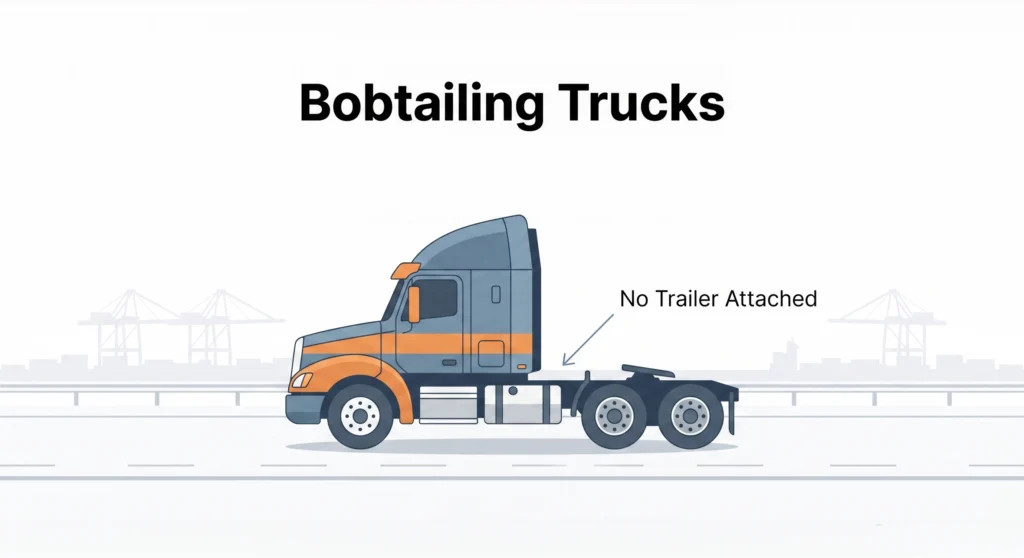
Bobtailing is a truck tractor driving on public roads with no trailer attached. The bobtail truck is the power unit by itself, the cab and engine that normally pulls a trailer. A driver runs bobtail for plain reasons. The cab heads out empty to pick up its first load, drives off after dropping a trailer at a yard, or moves between terminals to grab the next haul.
Bobtailing is not the same as deadheading, and the difference matters. A deadheading truck still pulls a trailer, just an empty one. A bobtail truck pulls nothing at all. Behind the wheel of either, the motor carrier still controls that cab whether a trailer is hooked up or not. That carrier is the trucking company that owns the tractor and answers for its driver.
The difference between the three setups a tractor can run in comes down to what sits behind the cab.
| Configuration | Trailer attached | Cargo on board | Typical use |
|---|---|---|---|
| Bobtail tractor | None | None | Driving to a pickup, returning from a drop, moving between yards |
| Deadhead tractor | Empty trailer | None | Repositioning an empty trailer toward the next load |
| Loaded tractor-trailer | Full trailer | Yes | Hauling freight under a load |
That empty back end is where a bobtail truck starts to behave in ways a loaded rig never would, beginning with how it handles the moment the driver hits the brakes.
Why a bobtailing truck handles differently
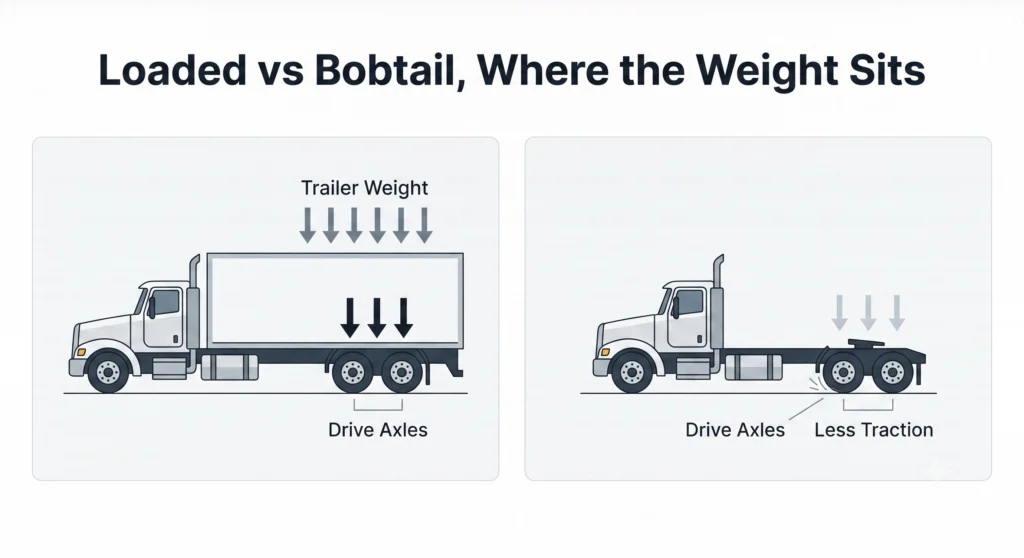
A bobtailing truck handles differently because its brakes and suspension are built for the weight of a loaded trailer that is not there. A tractor’s drive axles, the powered wheels under the back of the cab, are designed to carry thousands of pounds of trailer and cargo pressing down on them. That downward weight is what gives the tires their grip. Run the same tractor with no trailer, and far less weight sits over those drive axles. Less weight means less traction. Under hard braking, the rear wheels can lock up or lose their hold, and the cab can slide or swing in a way the driver does not expect.
The diagram below shows where the weight sits in each case.
Three things make an empty tractor riskier than it looks on the road.
- Braking traction drops. The brakes are balanced for a loaded trailer pushing down on the rear axles. With that weight gone, the drive wheels grip less and the stopping behavior changes. How much it changes depends on the tractor setup, the speed, and the road surface.
- Emergency maneuvers turn dangerous. A hard swerve or a panic stop on a light back end can break traction or make the cab slew sideways. A move that a loaded rig would absorb can put a bobtail tractor out of shape.
- Driver fatigue adds up. Bobtail runs usually come at the start or end of a shift, on short repeat trips between a yard and a terminal. Routine and tiredness slow a driver’s reaction right when the truck is least forgiving.
Knowing how a bobtail truck behaves matters most in the places where these empty cabs run every day. Around New Orleans, that means the roads feeding the port.
When and where bobtailing happens around New Orleans
Bobtailing happens whenever a tractor moves without a load, and around New Orleans it shows up most in the drayage traffic feeding the port. A cab runs bobtail between loads. It heads to a terminal to hook up a container, drops one and drives off empty, or repositions to the next pickup. That repositioning, moving the cab without hauling for a paying load, is what the trucking world calls non-trucking use.
Drayage is the short-haul trucking that shuttles containers between the port and nearby yards and warehouses. New Orleans runs on it. Tractors move in and out of the container terminals all day, running bobtail on the turnaround, empty in one direction after dropping or before grabbing a box. Much of that traffic feeds the Napoleon Avenue Container Terminal Complex, one of the Port of New Orleans container hubs on the river. These trucks share the same lanes everyone else uses, the I-10 corridor and the river-terminal approaches that carry port traffic through the city.
When one of these empty tractors causes a wreck on a port corridor, the injured driver is left with medical bills and a confusing insurance picture. People hurt in a port-corridor collision can get legal help after a bobtail truck crash in New Orleans from our truck accident team.
There is one more thing that separates a bobtail crash from an ordinary truck wreck, and it has nothing to do with how the truck drives. It is the question of which insurance company has to pay.
The coverage gap behind a bobtailing truck
A coverage gap opens up after a bobtail crash because the trucking company’s main insurance policy may not cover the tractor once it stops working in the business of trucking. A motor carrier’s primary liability policy generally covers the tractor while it is in the business of trucking. That means dispatched, under a load, or driving to pick one up. When the same cab runs bobtail and not for trucking purposes, that primary coverage can fall away.
A separate layer is built for exactly that situation. It is called bobtail liability, and it covers the tractor when it is operated not for trucking purposes. This coverage goes by more than one name, a bobtail policy, non-trucking-use coverage, or a non-trucking-use policy. It is provided through the business auto policy plus an ISO endorsement called CA 23 09, the Truckers Insurance for Non-Trucking Use form.
The bobtail coverage stack
Business auto policy: the underlying policy the non-trucking coverage attaches to.
ISO endorsement CA 23 09: the Truckers Insurance for Non-Trucking Use endorsement that adds the coverage.
Bobtail liability: what responds when the tractor is operated not for trucking purposes.
What happens when the insurance company you expected to pay says the policy does not apply? After a bobtail crash, the carrier’s insurer can deny coverage. It disclaims responsibility, arguing the driver was on personal time and off the trucking clock. It excludes the loss under a non-trucking-use exclusion, a coverage exclusion written into the policy for a cab that is not working for the business. The primary insurer may respond under a reservation of rights, stepping in to handle the claim while it reserves the right to walk away later.
Sorting this out is where the firm’s former insurance-defense insight matters. Lee Rudin identifies which policy is actually on the risk, untangles the business-auto and bobtail layers, and pursues the correct insurer. Much of that work turns on the dispatch records and the trip purpose, the paper trail that shows whether the cab was in the business of trucking at the moment of the crash.
Knowing the coverage can fall away is one thing. Knowing what to do about it after you have been hit is what protects your claim.
Untangle the insurance after a bobtail truck crash
Untangle the insurance after a bobtail truck crash by taking clear steps early. Get medical care right away, even if you feel fine. Report the crash and make sure a police report gets started. Write down or photograph anything that identifies the tractor and the trucking company, the name on the door, the DOT number, the license plate. Which insurer answers can depend on whether that cab was in the business of trucking when it hit you.
You have a deadline too. In Louisiana, a truck-crash injury on or after July 1, 2024, carries a two-year prescriptive period, the two-year window to file suit under La. C.C. art. 3493.1. Injuries before that date fall under the older one-year rule. The clock keeps running while the insurance question gets sorted, so starting early matters.
When a carrier disclaims coverage, we identify and pursue the right policy. If a bobtailing truck hurt you or someone in your family, a free case review with Lee Rudin and our truck accident team is a good place to start.